Short answer
Set your machine to your water’s hardness, fit the water filter it takes, and descale whenever it asks, with the descaler its maker names. In hard water that can mean every two to three months without a filter. The cycle takes about 15 to 40 minutes. The two mistakes to avoid are skipping the hardness setting and using vinegar, which several makers warn against.
- Time: about 15 to 40 minutes for the cycle, depending on the machine, plus rinsing
- Difficulty: Easy: most machines run a programme and tell you what to do next
- Rough cost: one dose of the maker’s descaler per descale, plus filter cartridges if your machine takes them
Safety: descaler is an acid: follow the advice on its label and keep it away from children. Hot water and steam come out of the spouts and wand during the cycle, so keep your hands clear. Switch off, unplug and let the machine cool before you take out the brew unit or other parts. If it leaks or shows a fault you can’t clear, stop and contact the maker.
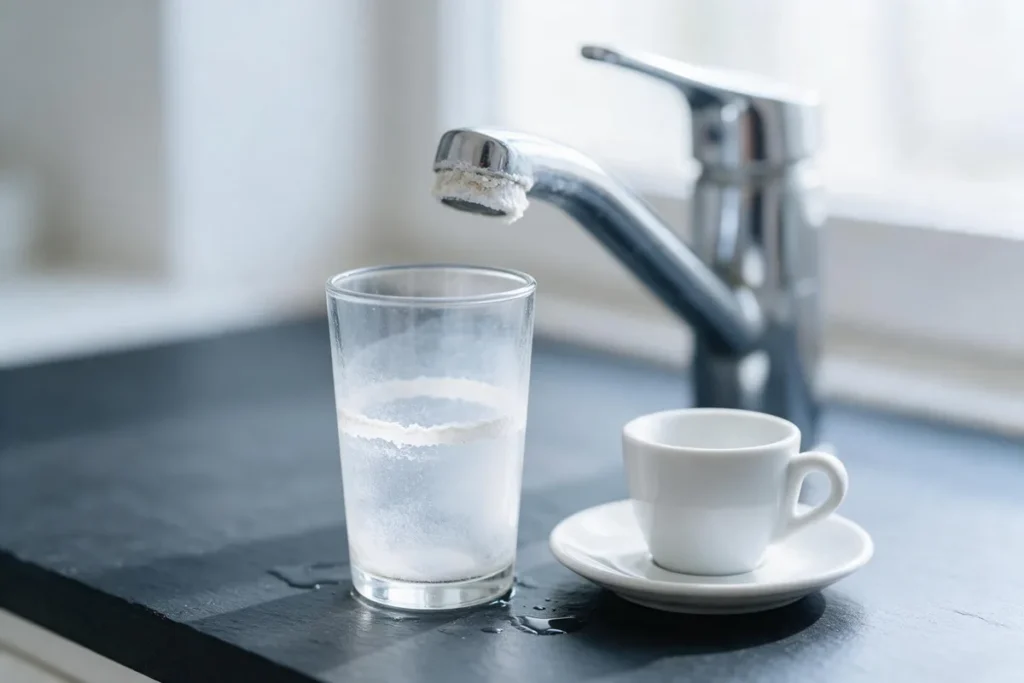
Hard water leaves scale on a coffee machine’s heating element, as it does in a kettle, and the Drinking Water Inspectorate says scale shortens an appliance’s life and makes it less efficient. Machines handle it three ways: a hardness setting that times the descale alert, a filter in the tank, and the descaling programme. This guide takes them in order, brand by brand, from the makers’ manuals. Still choosing? Our guide to which coffee machine to buy compares the types, and every bean-to-cup machine we track shows whether it takes a water filter.
What you’ll need
- Your machine’s manual, or the maker’s help page for your model
- Your water hardness: the test strip that comes with many machines, or your water company’s figure
- The descaler your manual names (part numbers are in the table below)
- A container as big as your manual asks for: from 1 litre for Siemens’ EQ.700 to 2 litres for De’Longhi’s Eletta Explore
- A new filter cartridge, if your machine takes one and it is due
Step 1: Find out how hard your water is
The DWI grades hardness by the calcium carbonate in the water: soft up to 100 mg/l, slightly hard 100 to 150, moderately hard 150 to 200, hard 200 to 300 and very hard above 300 mg/l. Its map shows only typical levels for England and Wales, and water varies locally, so for your own home ask your water company. Severn Trent’s postcode checker, for one, shows typical values for your area, including hardness in the units appliance makers use. Thames Water says all the water it supplies is hard. In Scotland and Northern Ireland, which the DWI page doesn’t cover, ask your own supplier.
Machines use their own scales instead, such as levels 1 to 4 or German degrees (°dH), so the quickest route is the test strip in the box: De’Longhi’s shows 1 to 4 red squares, and you set the machine to that number.
Step 2: Set the hardness on the machine
Many machines leave the factory on a hard setting: the Philips Series 3300 and the Magnifica S both start at level 4, and Melitta’s LOOK V and Optima filter machines on their highest. That suits hard water, but in a softer area the machine asks to descale more often than it needs to.
The setting changes the interval a lot. The Melitta Purista manual has it descale after 150 litres of water at its soft setting, 100 at medium, 70 at hard and 30 at very hard. For the Sage Bambino Plus, Sage suggests descaling every 90 days at hardness level 4 and every 60 days at level 6.
Where you set it varies. On the Nespresso Vertuo Up it is in the Nespresso app, not on the machine. Some machines have no setting at all: the Moccamaster KBG Select has no descale reminder, and Moccamaster asks you to descale every 100 brews, about one box of filter papers, or at least every three months.
Step 3: Fit the water filter, and change it on time
A filter cartridge in the tank means fewer descales, as long as you change it on time. Philips says that changing the 3300’s AquaClean filter whenever the machine asks allows up to 5,000 cups without descaling. The machine has to be free of scale before an AquaClean is first used, so fit one when the machine is new or straight after a descale. Brita filters don’t fit it.
- Melitta: change the Purista’s Pro Aqua filter every two months. With six changes a year and two cups a day, Melitta says one descale a year is enough.
- JURA: with a CLARIS Smart+ cartridge fitted, the JURA E8 doesn’t prompt for descaling at all; it asks for a new cartridge instead.
- De’Longhi: its filter lasts about two months (three weeks if the machine stands unused) and, De’Longhi says, means about 20 per cent fewer descales.
- Sage and Siemens: change Sage’s filter every three months, sooner in hard water, and Siemens’ BRITA Intenza within two months.
A filter jug is not the same thing: the DWI says carbon-and-resin jugs cut only temporary hardness, the part that comes out as scale. And don’t swap tap water for softened or distilled water without checking the manual (see the questions below); Moccamaster, for one, says salt-softened water can make its filter holder overflow.
Step 4: Descale when it asks, with the maker’s descaler
Don’t put the alert off: the Vertuo Lattissima and the Creatista Plus stop working until they are descaled, and Bosch’s Tassimo manual says to descale straight away. Use the descaler your manual names; the makers are blunt about it:
- De’Longhi says to use only its own descaler: faults from unsuitable descalers or wrong descaling may not be covered by its guarantee.
- Philips’ 3300 manual says that not descaling voids the warranty, and that descalers based on sulfuric, hydrochloric, sulfamic or acetic acid (vinegar) can damage the water circuit.
- Sage’s guarantee doesn’t cover faults caused by skipped descaling.
- Moccamaster’s warranty excludes damage from unsuitable cleaning or descaling agents, and blockages caused by limescale.
- Siemens says not to descale with vinegar, vinegar-based products, pure citric acid or descalers containing phosphoric acid, only with tablets made for the machine.
- Nespresso advises against vinegar and other home remedies; Tassimo’s descaling guide advises against vinegar, saying it can damage the machine and spoil the taste.
- The L’OR Barista is the odd one out: its Philips manual says only citric-acid descalers suit it.
So there is no one safe home remedy. Here is what each maker names:
| Machine | Descaler the maker names | Water filter | When the manual says to descale |
|---|---|---|---|
| De’Longhi bean-to-cup (Magnifica S, Eletta Explore) | Decalk Care, DLSC500 (one 100 ml dose) | DLSC002, about every 2 months | When the descale light comes on |
| De’Longhi espresso (Dedica Style, La Specialista Arte, Stilosa) | Decalk Care, DLSC500 (100 ml) | Not stated for these models | When the descale light comes on (Dedica Style: the steam light flashes); not stated for the Stilosa |
| Philips Series 3300 LatteGo | Philips descaling solution, one bottle (part number not stated) | AquaClean (part number not stated), after 95 litres or 3 months | When the Calc/Clean light comes on |
| Sage Bambino Plus and Barista Express Impress | Sage descaler, SES007NEU0NEU1 (Sage’s page doesn’t list these models: check first) | ClaroSwiss, SES008WHT0NEU1, every 3 months | Bambino Plus: every 90 days at hardness 4, 60 days at 6. Barista Express Impress: when the clean/descale light stays on |
| Sage Luxe Brewer Thermal | Not stated | ClaroSwiss, SES008WHT0NEU1, every 90 days | When the descale icon flashes |
| Melitta Purista | Anti Calc liquid, 6788302-uk | Pro Aqua, 6784658-uk, every 2 months | Every 3 months or when the light comes on; about once a year with the filter changed on time |
| Melitta filter machines (LOOK V Therm Timer, Optima Timer, AromaFresh Pro X) | Anti Calc powder, 6762482 (the manuals name Melitta’s Anti Calc liquid or, on the Optima, Swirl) | Not stated | LOOK V and Optima: when the CALC light comes on. AromaFresh Pro X: every four weeks, or when a red drop shows |
| Siemens EQ.300 and EQ.700 | Descaling tablets, TZ80002B | BRITA Intenza, TZ70003, within 2 months | When the service light asks (calc’nClean) |
| JURA E8 | Descaling tablets, 61848 (three per descale) | CLARIS Smart+, 24232 | No descale prompt with CLARIS fitted; without it, when the machine asks |
| Nespresso (Vertuo Up, Vertuo Lattissima, Essenza Mini, Creatista Plus) | Nespresso Descaling Kit, 142420 | Not stated | When the machine asks (Vertuo Up: maintenance button steady orange) |
| Philips L’OR Barista Sublime | L’OR Barista liquid descaler, CA6530 (half a bottle per descale) | Not stated | When the ristretto and lungo buttons flash quickly after brewing |
| Tassimo Style Friendly | Tassimo descaling tablets, TCZ6004 (two per descale) | Not stated | When the descale light comes on; Tassimo suggests about four times a year |
| Moccamaster KBG Select | Durgol Universal Descaler, Moccamaster article DUR116 | None named in the manual | Every 100 brews or at least every 3 months; no reminder |
We couldn’t read an official manual for the Ninja Luxe Café or the Dolce Gusto Genio S Plus, so follow the one that came with yours.
Step 5: Run the cycle and rinse
Follow your manual or the machine’s prompts; the shape of the job is the same:
- Take the filter out. De’Longhi, Melitta and Sage all say so; Melitta suggests keeping it in a glass of tap water.
- Fill the tank with descaler and water to the mark. On the Magnifica S that is a 100 ml dose of De’Longhi descaler to level A and a litre of water to level B; on the Vertuo Up, 0.6 litres of water and one unit of Nespresso descaler; on the Purista, 0.5 litres of Melitta Anti Calc solution.
- Put the container under the spouts and the steam wand, and start the programme. Let it finish: De’Longhi says the Magnifica Evo’s cycle can’t be stopped once it starts, and Melitta says the LOOK V’s programme mustn’t be interrupted.
- Rinse with fresh water. Moccamaster asks for two or three brews of clean water, Tassimo for three or four rinse cycles, and Nespresso for a full-tank rinse on the Vertuo Up, then 10 minutes’ rest.
- Refit the filter. De’Longhi has you refit it for the rinse. On the Philips 3300, fit and activate the AquaClean now, while the machine is free of scale.
The manuals put the cycle at about 15 minutes on the Vertuo Up, 25 on the Magnifica S and the Purista, 30 on the Philips 3300 and 40 for the Siemens EQ.300’s calc’nClean, which also cleans. GB rules make every home coffee machine drop to low power within 30 minutes of a descale, so it may switch itself off afterwards.
Troubleshooting
- The descale light comes on very often: De’Longhi says the hardness setting is probably higher than your water needs, so set it to match. Among the owner reviews we read, a Magnifica S owner was asked to descale within weeks despite soft water: one report, not a pattern, but the setting is the first thing to check.
- It asks for another rinse after descaling: on the Dedica Style, De’Longhi says the tank wasn’t filled to MAX for the rinse. Fill it to MAX and repeat the rinse.
- A filter machine brews slowly and makes a lot of steam: Moccamaster says the heater has scaled up: descale, more than once if needed.
Buying with hard water in mind? Our roundups of the best bean-to-cup coffee machines and the best espresso machines show which take a filter.
Descaling questions
How often should I descale a coffee machine in a hard-water area?
Whenever the machine asks, once its hardness setting matches your water. In hard water that is often every two to three months without a filter: Sage suggests every 60 to 90 days for the Bambino Plus at its harder settings, and Moccamaster every 100 brews or three months. A filter changed on time stretches it, to about once a year on Melitta’s Purista.
Can I descale a coffee machine with vinegar or citric acid?
Not unless your manual says so. Philips, Siemens, Nespresso and Tassimo all advise against vinegar, and Siemens also rules out pure citric acid. The L’OR Barista is the exception we found: its manual asks for a citric-acid descaler. Use the product your manual names, because several makers leave damage from the wrong descaler out of their guarantee.
Should I use bottled, filtered or softened water instead?
Ordinary cold tap water is what most manuals expect. The DWI advises keeping an unsoftened tap for drinking and cooking, Bosch says not to use chemically softened water in a Tassimo, and Sage warns against reverse-osmosis, distilled or very low-mineral water in its Oracle Jet. A filter jug helps only partly: the DWI says it cuts temporary hardness, not all of it.