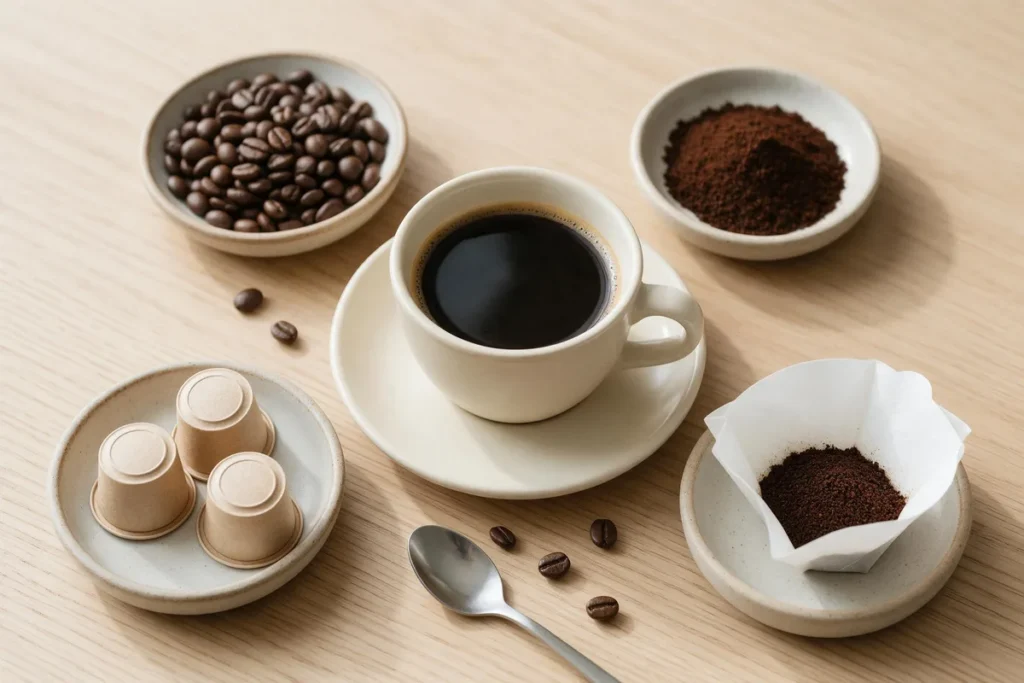
Short answer
Choose the type before the model, and let what you drink decide it. If most of your coffees are lattes and cappuccinos, a bean-to-cup machine with one-touch milk suits most homes, and our pick is the Philips Series 3300 LatteGo. Choose a pod machine for the least effort per cup, an espresso machine if you want café-style milk and enjoy the process, and a filter machine for black coffee by the jug.
The short answer
- What you drink decides the type. Milky drinks at a button point to bean-to-cup, black coffee by the mug to filter, and one quick cup with no fuss to pods.
- Daily effort and running cost pull in opposite directions. Pods ask least of you, but you pay for every capsule and can use only one system’s; beans ask for more cleaning but let you buy any coffee.
- Measure before you buy. The machines we track run from about 20 cm to 46 cm tall and up to 49 cm deep, so check your gap first.
The four types at a glance
| Bean-to-cup | Espresso | Pod | Filter | |
|---|---|---|---|---|
| What it makes | Espresso and long coffee from fresh beans; most add milk drinks at a button | Espresso shots you dose yourself, plus steamed milk | One drink per pod, from one system’s pods | A jug of black filter coffee |
| Milk | One-touch milk system or a steam wand, by model | Steam wand, manual or automatic | None, a separate frother, or built in on milk models | None |
| Every day | Empty the grounds and drip tray; rinse the milk system | Dose and tamp each shot; purge and wipe the steam wand | Empty the pod container and drip tray | Fit a paper filter; wash the jug |
| What you keep buying | Beans | Beans (with a grinder) or ground coffee | Pods | Ground coffee and filter papers |
| Heights we track | 33.4–38.5 cm | 28.5–41 cm | 20.4–31.5 cm | 33.5–46.3 cm |
Each type has its own comparison page, with every model and its current prices: every bean-to-cup machine we track, espresso machines, pod machines and filter coffee machines. The factors below are the ones UK buyers weigh most in the threads we read.
What you drink: milk or black
What it is: the drinks you make most often, and whether they have milk in them. This picks the type before anything else does.
Why it matters: a milk system adds to the price and to the daily cleaning, so it should earn its place. In the UK threads we read, the drinks people want are the first thing they weigh, and buyers who mix up an Americano and filter coffee end up with the wrong type.
What to look for:
- Mostly lattes, cappuccinos or flat whites: one-touch milk on a bean-to-cup machine, such as Philips’ two-part LatteGo jug; an automatic steam wand that textures milk in the jug for you, as on the Sage Bambino Plus; or a pod machine with a milk carafe, such as the Nespresso Vertuo Lattissima.
- Happy to froth milk by hand: a manual steam wand, as on the De’Longhi Magnifica S and most of the espresso machines we track. It costs less, but you have to learn the knack.
- Black coffee only: skip the milk system. The Melitta Purista is a bean-to-cup machine with none at all, 20 cm wide. For a jug at a time, a filter machine.
- Milk now and then: a machine without milk plus a separate frother. Nespresso sells its Aeroccino3 for machines with no milk system, such as the Vertuo Up.
Americano or filter coffee?
An Americano is an espresso topped up with hot water. Filter coffee is hot water dripped through ground coffee in a paper filter, usually a jug at a time. To make an Americano without boiling the kettle, you need an espresso or bean-to-cup machine that gives hot water: the Philips 3300 has a hot-water button, the Magnifica S and the Bambino Plus give hot water through the steam wand, and the Purista has no hot-water outlet at all. Many bean-to-cup machines also have a longer black coffee on a button, which De’Longhi calls a long coffee and Melitta a café crème. For filter coffee, buy a filter machine.
Daily effort
What it is: what the machine asks of you every day, every week and every few months, from the makers’ own cleaning schedules.
Why it matters: in the threads we read, fiddly cleaning is one of the most common reasons owners give for going back to pods.
What to look for:
- Pod: the least. Put a pod in and press. Nespresso asks you to empty and rinse the Vertuo Up’s pod basket daily, run a cleaning cycle about once a month, and descale when the light comes on.
- Bean-to-cup: a button per drink, then regular upkeep. Philips asks you to rinse the 3300’s brew group weekly, clean it with an oil-remover tablet monthly, grease it every two months and rinse the LatteGo jug after each use. De’Longhi asks for the Magnifica S’s brew unit to be rinsed at least once a month and its steam wand cleaned after every use. A brew unit that lifts out for rinsing is worth having.
- Espresso: the most involved. You grind or buy ground coffee, dose the basket (16 to 19 g for a double on the Bambino Plus), tamp it and texture the milk. The Bambino Plus prompts a cleaning cycle after 200 shots. Owners we read say Sage’s Barista models took trial and error on the grind at first.
- Filter: little day to day. Wash the jug and filter holder. Moccamaster asks for a descale every 100 brews or three months, and a clean of the inside four to six times a year.
Running cost per cup
What it is: what each cup costs in coffee, plus its share of the descaler, water filters and cleaning tablets the machine uses. Not the machine’s price.
Why it matters: the cost per cup runs for years. Owners in the UK threads we read say again and again that beans work out far cheaper per cup than pods, and that a machine pays its way against coffee-shop spending, but their sums vary with the beans and pods they buy. Do your own with your own prices.
What to look for: the sum, not a headline figure.
- Beans or ground coffee: the price of a bag divided by the cups it makes. The Bambino Plus’s double basket takes 16 to 19 g, so a 1 kg bag makes about 55 doubles at 18 g. For filter, Moccamaster suggests 60 g of coffee per litre, about 75 g for a full 1.25 litre jug, so a kilo makes about 13 full jugs.
- Pods: the price of one pod times the pods you use per drink. Some owners in the threads we read say they use extra pods to get a stronger drink.
- Upkeep: a year’s consumables divided by a year’s cups. Philips uses a whole bottle of its descaler per descale and an AquaClean filter at least every three months; a bottle of De’Longhi’s Decalk Care holds five doses; the Bambino Plus uses one cleaning tablet every 200 shots; a filter machine takes one paper per brew.
Our explainer, is a bean-to-cup machine cheaper than pods?, works through the sums step by step.
Size and fit
What it is: the height, width and depth on the maker’s spec sheet, plus the room you need to open a lid, slide out the water tank or lift the jug.
Why it matters: a machine that won’t sit under your wall cupboards ends up on the open worktop.
What to look for: measure from the worktop to the underside of your cupboards, then compare it with the height on each product page. The machines we track run from 20.4 cm tall (the Nespresso Essenza Mini) to 46.3 cm (the Melitta AromaFresh Pro X, a filter machine with a grinder). Leave room to open anything you fill from the top. Depth catches people out too: the bean-to-cup machines we track are 43 to 46.7 cm deep, and the Vertuo Up is 49 cm deep though only 12 cm wide. Short of space? See our compact coffee machines that fit under kitchen cupboards.
Warranty, parts and upkeep
What it is: how long the guarantee lasts, what it leaves out, and whether you can buy the filters, descaler and wear parts by part number.
Why it matters: no source we trust publishes failure rates by brand, so these are the durability signals you can check before you buy. Among the owner reviews we read, owners of the Magnifica S and earlier De’Longhi models describe machines lasting from 3 to 13 years, alongside a few early failures, and Bambino Plus owners report years of office use and quick replacements from Sage. These are anecdotes, not failure rates.
What to look for: the years, then the exclusions. Philips, De’Longhi, Sage, Melitta and Nespresso give two years on the machines in this guide; Moccamaster gives five on the KBG Select, but not on loose parts such as the jug or on damage from unsuitable descalers. Sage’s guarantee doesn’t cover faults caused by skipped descaling, and De’Longhi says faults from an unsuitable descaler may not be covered. So budget for the maker’s own descaler, and read how to descale in a hard-water area before the first alert.
Which type suits you?
Bean-to-cup: milk drinks at a button
Choose bean-to-cup if you want fresh-ground coffee and milk drinks without learning a skill. The Philips Series 3300 LatteGo is our pick for most homes: six drinks on the panel, including cappuccino, latte macchiato and iced coffee, a two-part milk jug with no tubes that rinses under the tap or goes in the dishwasher, and an AquaClean filter that, changed when the machine asks, Philips says can put off descaling for up to 5,000 cups. Its catches are the weekly brew-group rinse and milk drinks made one cup at a time. For less, the De’Longhi Magnifica S has two buttons, a strength dial and a steam wand, with no one-touch cappuccino. Torn between the two? Read De’Longhi vs Philips bean-to-cup, or see the best bean-to-cup coffee machines.
Espresso: café-style coffee, more involved
Choose a portafilter espresso machine if you enjoy the process and want to control the shot and the milk. Several owners we read say a bean-to-cup shot isn’t the same as one from a portafilter, so if espresso itself is the point, this is the type. The Sage Bambino Plus is the easy way in: Sage says it heats in 3 seconds, and its automatic steam wand textures milk in the jug at three temperatures and three foam levels, so flat whites need no steaming skill. It has no grinder, though: you need a burr grinder or fresh pre-ground coffee. If you want the grinder built in, look at the Sage Barista Express Impress, with 25 grind settings. More in the best espresso machines for home.
Pod: one quick cup, least effort
Choose a pod machine for a quick single cup, a household that wants different drinks, or the least cleaning. Choosing the machine means choosing its pods, often for years, because most systems take only their own. The Nespresso Vertuo Up is our pod pick: Nespresso quotes a heat-up of about 3 seconds, it has a 1.4 litre tank and it brews all seven Vertuo cup sizes, from ristretto to a carafe. It takes barcoded Vertuo pods only, so Original capsules and third-party pods don’t fit, and it has no milk system. Weighing up the two Nespresso systems? Read Nespresso Original vs Vertuo; for milky drinks and hot chocolate, Dolce Gusto vs Tassimo; and for every system, the best pod coffee machines.
Filter: black coffee by the jug
Choose a filter machine if you drink black coffee by the mug, several cups at a time. The Moccamaster KBG Select is our filter pick: Moccamaster says it brews a full 1.25 litre jug in about six minutes with water at 92 to 96 °C, a half-jug setting slows the water so small batches still brew properly, and it carries a five-year warranty. It has no timer, and its glass jug sits on a hotplate that switches off 40 minutes after brewing starts. If you want coffee ready when you wake, or a thermal jug instead of a hotplate, the Melitta LOOK V Therm Timer has both.
What each budget buys
Budget
Under £300
Most pod machines without built-in milk, filter machines including thermal-jug and grind-and-brew models, and small pump espresso machines with a frother you work by hand. None of the bean-to-cup machines we track sits in this band.
Mid-range
£300 to £600
The first bean-to-cup machines, with a steam wand or one-touch milk; compact espresso machines that texture milk for you, and the first with a grinder built in; and pod machines with milk built in. For most milk drinkers, this is where to look.
Premium
Over £600
Bean-to-cup machines with more drinks, two bean hoppers, an app or a bigger tank, and espresso machines that grind, dose and help you tamp. Pay for these only if you will use the extras every day.
These bands follow the prices we track. Sales move machines between them, so check the current prices.
Our top picks
One pick each for bean-to-cup, espresso and pods, plus a cheaper way into bean-to-cup; the filter pick, the Moccamaster KBG Select, is in the filter section above. Each badge is the one a machine earns within its own type, so match the picks to what you drink rather than ranking them against each other.
-
Best value
Philips Series 3300 LatteGo EP3347/90
One-touch milk drinks from an easy-clean LatteGo jug, for less
- 1.8 L tank
- 37.1 cm tall
- 2-yr warranty
-
Best budget
De’Longhi Magnifica S ECAM22.110.B
Simple, proven bean-to-cup with a steam wand for milk
- 1.8 L tank
- 34 cm tall
- 2-yr warranty
-
Best for milk drinks
Sage the Bambino Plus
Hands-free milk texturing with three temperatures and three foam levels
- 1.9 L tank
- 2-yr warranty
- 30.4 cm tall
-
Best overall
Nespresso Vertuo Up
Fast heat-up, big tank and every Vertuo cup size in a slim body
- 1.4 L tank
- 25.5 cm tall
- 2-yr warranty
How we choose
- Started from what buyers weigh: the drinks they make, the daily effort, the cost per cup and the space they have.
- Compared the makers’ published specs, manuals and guarantee terms for every machine we track across the four types.
- Checked prices by hand at UK retailers, including Philips, De’Longhi, Sage, John Lewis, Hughes and Redber Coffee, and show the date we checked.
- Read owner reviews and forum posts for reported problems. The samples are small, and we treat them as anecdotes, not failure rates.
What we don’t do: lab-test every product. When we have used one ourselves, the review says so.
Questions about choosing a coffee machine
Will a coffee machine fit under my wall cupboards?
Measure first, because heights vary a lot: the machines we track run from 20.4 cm to 46.3 cm tall. Measure from the worktop to the underside of the cupboard, then allow room to open anything you fill from the top and to slide the water tank out. Check depth as well; some machines are 45 cm deep or more. Every product page lists the maker’s height, width and depth.
Does a coffee machine switch itself off?
Yes: since 2015, GB rules have required home coffee machines to drop to low power on their own. Espresso and bean-to-cup machines must do it within 30 minutes of the last brew or heating. Filter machines with an insulated jug must do it within 5 minutes of brewing, and those with a glass jug on a hotplate within 40 minutes. Every machine must also power down within 30 minutes of a descale.
How often will I need to descale?
Whenever the machine asks, once its water hardness setting matches your water, and more often in hard water. Sage suggests every 90 days for the Bambino Plus at hardness level 4 and every 60 days at level 6. Moccamaster asks for every 100 brews or three months. Philips says AquaClean filters changed when asked allow up to 5,000 cups between descales. Our descaling guide covers each brand.
Which coffee machine brand is most reliable?
No source we trust publishes failure rates by brand, so we don’t rank brands on reliability. What you can check is the guarantee and its exclusions: most machines here carry two years and the Moccamaster five, and several makers exclude damage from skipped descaling or the wrong descaler. Filters, descaler and seals sold by part number, and a UK repair route, are good signs.
What are my rights if a new coffee machine is faulty?
Under the Consumer Rights Act 2015 you can reject a faulty machine for a refund within 30 days of delivery. After that, you can ask for a repair or replacement, which the seller must carry out in a reasonable time and pay for. A fault that shows within six months is presumed to have been there from the start. If one repair fails, you can ask for a price reduction or reject it.
Can I recycle coffee pods in the UK?
Yes, through the brands’ schemes. Nespresso UK takes back used Original and Vertuo capsules free in its recycling bag, by Royal Mail collection, at a Royal Mail location or at a Nespresso Boutique. Podback, set up in 2021 by Nestlé and Jacobs Douwe Egberts, takes member brands’ pods: aluminium pods in white bags, plastic ones such as Tassimo and Dolce Gusto in green. Some councils collect them at the kerbside.